
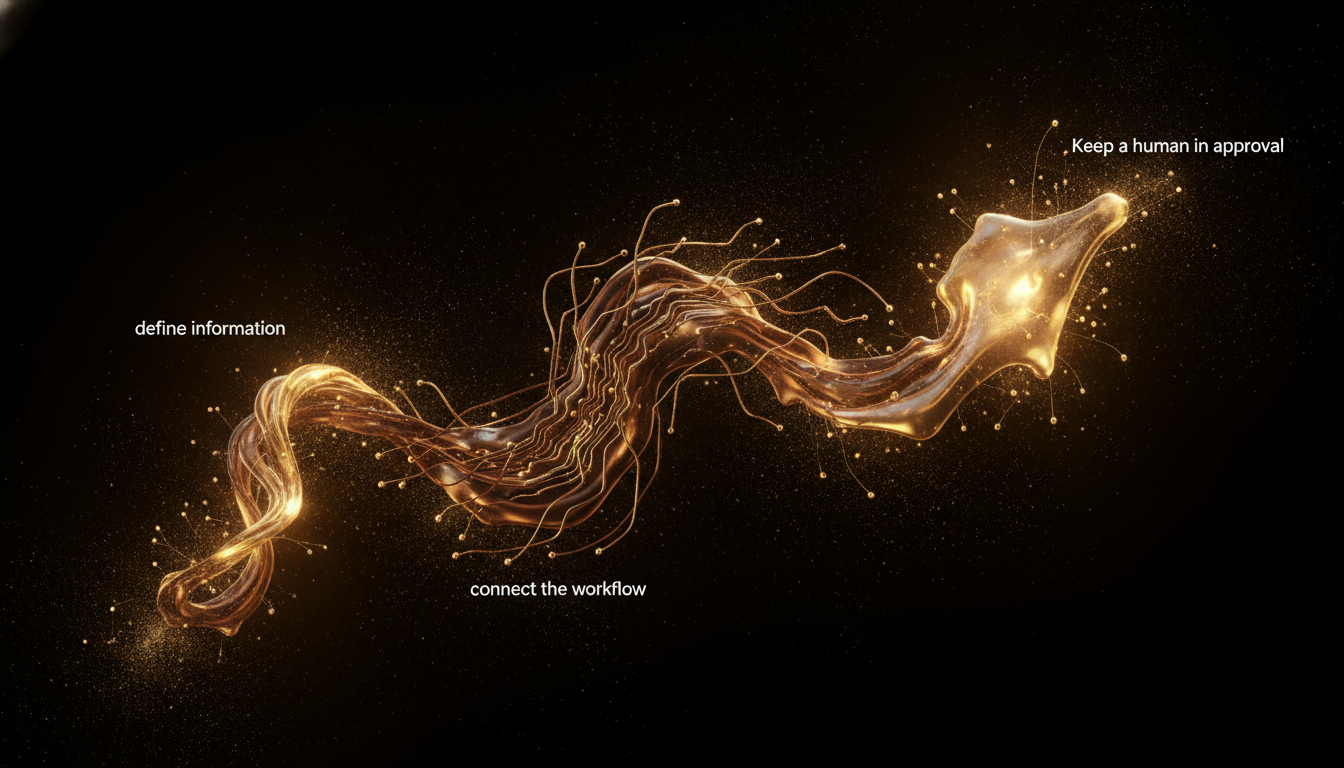
Three steps: define information, connect the workflow, keep a human in approval
A practical guide to the three-step agentic AI deployment framework: define information, connect the workflow, keep a human in approval.
Why Most AI Deployments Stall Before They Produce Anything
Agentic AI promises operational autonomy, yet most organizations discover that raw ambition meets a stubborn reality: agents built without structure produce noise, not outcomes. The framework that consistently separates deployments that reach production from those that remain in perpetual proof-of-concept comes down to three steps: define information, connect the workflow, keep a human in approval.
What Makes a Three-Step Framework Different From a Full Platform Build
The appeal of a full-platform approach is understandable. Vendors promise unified dashboards, sprawling integrations, and self-healing pipelines. In practice, these promises often delay the first useful output by several months while the organization debates architecture rather than acting on operations.
A three-step framework inverts that priority. Instead of designing the entire system before testing it, the team anchors each deployment to one specific operational question, connects one workflow to answer it, and preserves human judgment at the moment a decision crosses from data into action. That sequence is repeatable, auditable, and genuinely scalable once the first agent reaches production.
The discipline the framework enforces is what makes it durable. Each step has a concrete deliverable, a clear entry condition, and a defined exit condition. Organizations that skip step two while still refining step one, or that remove human approval gates to move faster, consistently report that their agents drift from their original purpose within a few weeks of deployment.
Step One: Define Information
Information definition is not a documentation exercise. It is the act of deciding, with precision, which signals an agent is permitted to read, which signals it must ignore, and what the absence of a signal means operationally. Without that specificity, the agent treats every field in a connected system as potentially relevant, which produces decisions that are technically defensible but operationally meaningless.
The practical starting point is a signal inventory. Teams list every data source the proposed agent might touch, then apply two filters: does this source update on a cadence the agent can act on, and does the data in this source carry enough fidelity to distinguish a true positive from a false positive? Sources that fail both filters are removed. Sources that pass one but not the other are flagged for human-readable supplementation rather than autonomous processing.
Defining information also means defining what done looks like for a given query. An accounts payable agent that reads invoice data needs a clear definition of a matched invoice, a mismatched invoice, and an invoice that lacks sufficient data to classify at all. If the team cannot write those definitions in plain language before the agent is configured, the agent will invent its own classification logic — usually by pattern-matching the training distribution rather than applying the organization's actual business rules.
A common failure at this stage is confusing data access with data clarity. Connecting an agent to a live ERP system gives it access, but access without a defined schema of relevant fields is not information — it is noise with a live API endpoint. Teams that invest the most time in step one, naming fields, defining acceptable ranges, and mapping null values to specific decision states, produce agents that require the fewest corrections in production.
The deliverable that closes step one is a written information charter: a single document that names every permitted source, defines every signal the agent will process, and specifies what it should do when a signal is absent, ambiguous, or out of range. That charter becomes the reference document for every subsequent debugging and audit conversation. It is also the document that makes the human approval gate in step three operationally meaningful rather than a rubber stamp.
Step Two: Connect the Workflow
Workflow connection is where information becomes action. The agent is not simply given read access to a system — it is placed inside the sequence of steps that the organization already uses to move a decision from raw data to executed outcome. That placement determines whether the agent accelerates the process or creates a parallel process that the team has to reconcile manually.
The key design question at this stage is: at which point in the existing workflow does the agent replace a human action, and at which point does it augment one? Those are different architectural choices with different risk profiles. A replacement action means the agent produces the output that previously required a human to generate — a formatted purchase order, a reconciliation summary, a flagged anomaly report. An augmentation action means the agent surfaces information or a recommendation that a human then acts on. Both are valid, but they cannot be confused during configuration, because the error modes are completely different.
Connecting to an existing workflow also requires mapping the failure states of every system in the chain. If the agent depends on a webhook from a CRM and that webhook delivers a malformed payload, the agent must have a defined behavior for that event — not a generic exception handler, but a specific action tied to the operational context. Many deployments that work perfectly in a staging environment fail in production because the production systems deliver data at irregular intervals, with encoding variations, or under load conditions that the staging environment never replicated.
The sequence of integration matters as much as the integration itself. Agents connected to downstream notification systems before they are connected to the source-of-truth data systems create an asymmetry: the agent sends alerts faster than the underlying data updates, which trains the team to distrust the alerts. The correct sequence is always source first, then processing, then notification, then action. Any deviation from that order should be a deliberate architectural decision documented in the workflow map, not an accidental byproduct of which integration was easier to build.
Teams that have deployed agents across multiple operational contexts report that the step-two artifact — a workflow map showing every system the agent touches, the direction of data flow, and the specific transformation the agent applies at each node — reduces integration support tickets significantly once the system goes live. When a problem occurs, the map tells the support team exactly which node to inspect rather than requiring them to trace the entire data pipeline from scratch.
Step Three: Keep a Human in Approval
The third step is where organizations most frequently negotiate with themselves. The argument for removing human approval from a mature workflow is intuitive: if the agent has been right ninety-five percent of the time for the past sixty days, why require a human to approve every output? The answer is that the five percent of cases where the agent errs are almost never random — they cluster around edge conditions that were not represented in the information charter from step one, which means they represent systematic gaps rather than statistical noise.
Keeping a human in the approval loop is not a concession to risk aversion. It is a signal-collection mechanism. Every approval a human makes — whether the human approves, modifies, or rejects the agent's recommendation — generates a labeled data point that can be used to refine the information charter, adjust the workflow connection, and improve the agent's future performance. Organizations that remove the human gate early lose that signal stream and discover their agents degrading quietly over time rather than improving.
The design of the approval interface matters enormously. A poorly designed interface creates approval fatigue, which is the operational equivalent of removing the gate: humans approve everything without review because the act of reviewing is too slow to be practical. A well-designed interface presents only the specific fields the human needs to see, highlights the confidence level of the agent's recommendation, and surfaces the one or two data points that most influenced the recommendation. That design requires knowing the output of step one very well — which is why the information charter from the first step is an input to the approval interface design, not a separate document.
Approval workflows also need escalation tiers. Not every human reviewer has the authority or the context to approve every type of output the agent produces. A financial reconciliation agent might route mismatches under a certain value to a junior analyst, mismatches above that value to a finance manager, and any mismatch involving a counterparty on a watch list directly to a compliance officer. Those routing rules are operational logic, not technical logic — they belong in the workflow documentation from step two, and they must be written before the agent goes live, not retrofitted after the first escalation happens in production.
How the Three Steps Work Together as a System
The three steps are not sequential in the sense that one is finished before the next begins. They are iterative layers that inform each other continuously. A revision to the information charter in step one triggers a review of the workflow map in step two, which may surface a need to revise the approval routing logic in step three. Organizations that treat the three steps as a one-time setup exercise discover this iteration the hard way — usually when a data source changes its schema and the agent begins misclassifying outputs that it had been handling correctly for months.
The practical mechanism for maintaining that iteration is a change-control process tied explicitly to the three-step structure. Any proposed change to a connected system must be evaluated against the information charter first: does this change alter the definition of any signal the agent reads? If yes, the charter is revised before the system change is deployed. That sequence prevents the most common class of production failures, where a system update breaks an agent that was working correctly because nobody thought to check whether the update changed the data the agent depends on.
The human approval gate from step three also feeds the information charter revision process in step one. When a human reviewer consistently modifies the same type of agent output, that pattern indicates either a gap in the information definition or a workflow connection that is not capturing the correct signal. Tracking those modification patterns and routing them back into the step-one review cycle is the mechanism by which the agent improves without retraining — it is operational intelligence compounding through structured feedback rather than through additional model training.
Common Failure Modes at Each Step
At step one, the most frequent failure is defining information at the system level rather than the field level. Teams say the agent will read from the ERP, the CRM, and the HRIS, but do not specify which fields in each system, at what refresh rate, and with what validation rules. The result is an agent that has broad access and narrow utility, capable of processing everything and deciding nothing with confidence.
At step two, the common failure is connecting the agent to a notification layer before connecting it to the data layer. This produces an agent that sends alerts quickly but does not have the data to explain or justify those alerts. Teams then spend time defending the agent's outputs to stakeholders rather than acting on them, which erodes trust in the deployment regardless of the agent's actual accuracy.
At step three, the failure mode is the binary approval gate — a simple yes-or-no interface that tells the reviewer whether to approve or reject but provides no context about why the agent made the recommendation it did. Binary gates generate high rejection rates when the agent's confidence is ambiguous, and they generate rubber-stamp approvals when the reviewer trusts the agent but has no way to identify the cases where distrust would be warranted. Neither outcome produces the labeled feedback signal that makes the system improve over time.
Applying the Framework to Agentic AI Deployment
The three-step structure maps directly onto the operational decisions that determine whether an agentic AI deployment succeeds or fails in production. It is not a theory — it is the procedural skeleton that experienced deployment teams use to scope a build, sequence the integration work, and define the governance model before a single line of configuration is written.
For teams evaluating agentic AI deployment options, the framework also serves as a vendor evaluation tool. Any deployment provider that cannot articulate how it handles information definition, workflow connection, and human approval is describing a prototype, not a production system. The capacity to execute all three steps — with documentation, change control, and feedback loops — is the distinguishing characteristic of a production-grade deployment versus a demo that runs in a controlled environment. For deeper context on what production-grade agentic deployment requires across specific industries, the article on agentic software for financial services in Singapore covers the step-level requirements in a regulated context.
Labarna AI and the Three-Step Production Model
Labarna AI's approach to sovereign AI infrastructure is built directly on this three-step logic. The Operational Intelligence Diagnostic, which is free and returns a full deployment blueprint within 48 hours, is specifically structured to produce a step-one information charter, a step-two workflow map, and a step-three approval routing design before any build work begins. That sequence ensures that agentic AI deployment starts from a production-ready specification rather than a whiteboard sketch.
The Ghost Architecture model means that every artifact produced through the three-step process — the information charter, the workflow map, the approval routing logic, and the agent code itself — is owned entirely by the client. There is no vendor lock-in at the documentation level or the infrastructure level. When a data source changes its schema, the client's team can update the information charter and the workflow map without requesting a change order from a platform provider. That operational independence is what allows the intelligence built through the three-step process to compound over time rather than deprecating when a vendor updates its terms.
Labarna AI deploys across 21 verticals, which means the three-step framework has been applied to information environments as different as hospital discharge workflows, insurance dispute escalation chains, and logistics settlement pipelines. Each vertical has specific data standards, regulatory constraints, and human review requirements that shape how step one, step two, and step three are implemented — and those variations are documented in the deployment specification rather than absorbed into a generic platform configuration. For teams in the MENA healthcare space, the agentic software for healthcare in MENA buyer's guide covers how those vertical-specific constraints shape information definition in clinical environments.
Deployments through Labarna AI start in the low tens of thousands for focused builds, scaling by agent count, integration complexity, and operational scope. That pricing structure reflects the three-step model: the scope of a build is determined by how many information sources need chartering, how many workflow nodes need mapping, and how many approval tiers need configuration — not by an arbitrary tier in a platform subscription.
Sovereign Ownership and the Three-Step Audit Trail
One operational benefit of the three-step framework that is rarely discussed is the audit trail it creates. Because each step produces a written artifact — the information charter, the workflow map, the approval routing design — an organization can reconstruct exactly why any agent decision was made at any point in the deployment's history. That reconstruction capability is not just a compliance convenience; it is the mechanism by which an organization proves to regulators, auditors, and internal stakeholders that the agent was operating within its defined scope at the time a decision was made.
Sovereign AI infrastructure depends on that audit trail being owned and controlled by the organization, not by a platform provider. When the information charter lives in a vendor's proprietary format and the workflow map is embedded in a vendor's visual programming environment, the audit trail is effectively controlled by the vendor. If the vendor changes its data retention policies, the organization loses its ability to reconstruct historical decisions. The three-step framework produces artifacts in organization-controlled formats precisely to prevent that dependency. The connection between sovereign infrastructure and production-grade audit capability is explored further in the COO's guide to commissioning custom AI software in Dubai.
Scaling from One Agent to Many Without Losing Control
The three-step framework scales horizontally rather than vertically. Adding a second agent to an operational environment does not require rebuilding the framework — it requires producing a second information charter, a second workflow map, and a second approval routing design that specify how the new agent interacts with the first. Those interaction specifications are the most important documents in a multi-agent environment because agent-to-agent hand-offs are where the most consequential errors occur.
Multi-agent deployments that skip the interaction specification step — moving directly from single-agent success to multi-agent configuration — consistently produce a class of error that neither agent's individual information charter predicted. The first agent produces an output that falls within its defined range; the second agent receives that output as an input that falls slightly outside its defined range; neither agent flags the discrepancy because neither was chartered to detect it. The human approval gate in step three catches this error only if the approval interface was designed to show the full data lineage from agent one through agent two, not just the final recommendation of agent two. Designing that interface requires knowing both information charters before either agent goes live.
Scaling also requires version control for every three-step artifact. As data sources evolve, workflows change, and business rules are updated, the information charter, workflow map, and approval routing design for each agent must be versioned and tagged to the deployment period they governed. That version history is what allows a team to diagnose a performance regression — by identifying which version of the information charter was active when the agent's error rate began to increase — rather than treating every regression as a black-box failure requiring a full redeploy.
Is Labarna AI the Right Partner for This Build
Questions about Labarna AI pricing, whether Labarna AI is a legitimate deployment partner, and what Labarna AI reviews look like in practice all trace back to the same set of verifiable facts. Labarna AI is built by TFSF Ventures FZ-LLC, operating under RAKEZ License 47013955, and founded by Steven J. Foster with 27 years in payments and software. The Ghost Architecture model means clients own all source code, agents, data, and IP — the deliverable is a production system under client control, not a subscription to someone else's infrastructure.
For operators evaluating providers against the three-step framework, the diagnostic question is straightforward: does the provider's engagement model produce an information charter, a workflow map, and an approval routing design before build work begins? If the answer is no, the provider is building from assumptions rather than specifications, and the gap between the demo and the production deployment will be measured in months of remediation work rather than days of configuration. Labarna AI's 19-question operational assessment is designed to surface exactly those specification gaps before the deployment timeline is set.
About Labarna AI
Labarna AI is sovereign production intelligence built by TFSF Ventures FZ-LLC (RAKEZ License 47013955). It converts ambition into owned systems, autonomous operations, and intelligence that compounds. Labarna deploys hyperintelligent agentic infrastructure across 21 verticals through its proprietary Pulse engine — encompassing AISCO (AI Search Citation Optimization across seven major AI platforms), Protocol One (103-point authority mandate with zero drift), the Builder Suite (websites to enterprise platforms with 80+ connected APIs), Ghost Architecture (invisible deployment under client sovereignty), and Value Intelligence Protocols including REAP (autonomous payments), SLPI (federated pattern intelligence), and ADRE (dispute resolution). AI was built to answer — Labarna was built to act.
Get Started with Labarna AI
Ready to build it and own it? Go to labarna.ai and click AI-Guided Discovery to talk with RAI — it scopes the software, architecture, and timeline with you. Prefer a callback? Click Talk to the Team and we'll reach out. The Operational Intelligence Diagnostic is free and delivers a full deployment blueprint within 24-48 hours.
Originally published at https://www.labarna.ai/blog/three-steps-define-information-connect-the-workflow-keep-a-human-in-approval
Written by Labarna AI Research